Build & Renovate cost guide
Garage Door Cost 2026: Roller, Sectional and Repair Prices
Typical cost in Australia (2026, inc. GST)
$900 to $6,000 per door
supplied and installed; single roller to insulated double sectional, motor extra
A new garage door in Australia costs about $900 to $6,000 installed in 2026. A single roller door is usually $900 to $1,800, a double roller door $1,400 to $2,600, and a double sectional door $2,200 to $4,500. A motor adds $600 to $1,200. Custom timber, insulated and cyclone-rated doors cost more, and removing an old door, new framing and electrical work add to the bill.
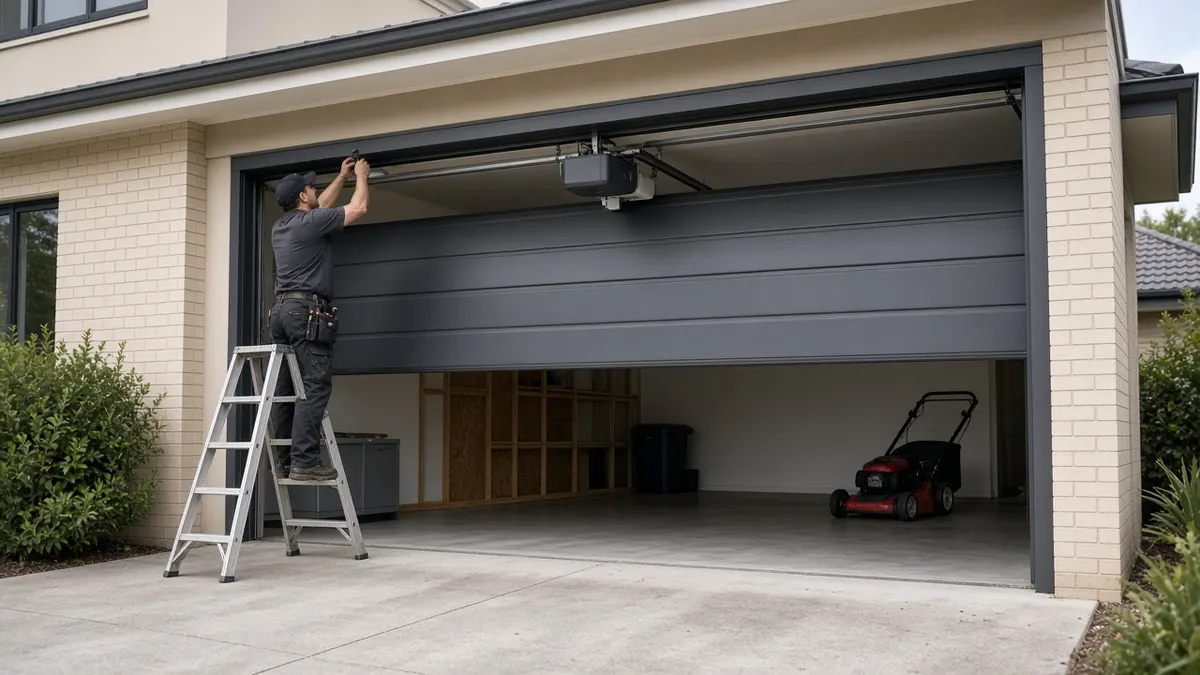
A new garage door costs about $900 to $6,000 supplied and installed in Australia in 2026, depending on the type, size and finish. A basic single roller door sits at the bottom of that range and an insulated double sectional door with a timber-look finish at the top. Add $600 to $1,200 for an automatic opener if it is not included. Fully custom timber, glass or architectural doors start around $5,000 and can pass $12,000.
Repairs are much cheaper. Most service calls cost $150 to $300, and replacing broken springs on a sectional door usually costs $250 to $550. The prices below are indicative and include GST. Door suppliers run frequent promotions, so it pays to get at least three written quotes for the same door size, model and motor.
Garage door prices by type
| Door type | Single (about 2.4 m wide) | Double (about 4.8 m wide) |
|---|---|---|
| Roller door, Colorbond steel, manual | $900 to $1,800 | $1,400 to $2,600 |
| Sectional door, steel, standard profile | $1,500 to $2,800 | $2,200 to $4,500 |
| Sectional door, insulated or timber-look | $2,200 to $3,800 | $3,200 to $6,000 |
| Tilt or panel lift door | $1,200 to $2,500 | $1,800 to $3,500 |
| Custom timber, aluminium slat or glass | $3,500 to $7,000 | $5,000 to $12,000+ |
| Automatic opener (motor), installed | $600 to $1,000 | $700 to $1,200, more for heavy doors |
Most prices include removing and disposing of the old door if it is a straight swap. If the opening needs reframing, a new lintel, or new jambs because the old ones are rotten or out of square, expect another $300 to $1,500. Oversized doors, such as 5.4 m double doors or 2.4 m high doors for caravans and 4WDs, cost 15% to 40% more than standard sizes because they need heavier springs, tracks and motors.
Choosing between door types
Roller doors
A roller door is a single curtain of corrugated steel that rolls up into a drum above the opening. It is the cheapest and simplest option and suits most garages and sheds. It needs about 400 to 500 mm of headroom above the opening for the drum, and the corrugated look is plain. Roller doors are also noisier and less insulated than sectional doors. For a backyard shed or a garage that does not face the street, they are the sensible choice.
Sectional doors
A sectional door is made of horizontal panels hinged together. It runs up on tracks and sits flat under the garage ceiling when open. It seals better, runs more quietly and comes in far more finishes, including flat panels, ribbed profiles, timber-look steel and windows. Sectional doors need more headroom and clear ceiling space inside than roller doors, and they cost more, but on a street-facing garage they look much better.
Tilt or panel lift doors
A tilt door is one solid panel that swings up and out. It was common on older brick homes and is still used where the owner wants the door clad to match the house. It needs clear space in front of the garage to swing out, and the springs and hardware wear over time. Many tilt doors are replaced with sectional doors at the end of their life.
Custom and architectural doors
Custom doors are clad in timber, aluminium slats, composite panels or glass, often to match a house facade. They look striking but cost more, are heavier, and may need special motors. Timber doors also need regular oiling or painting, especially on west-facing garages.
Measuring up: headroom, sideroom and the opening
Before any supplier can quote properly, they need four measurements: the width and height of the opening, the headroom between the top of the opening and the ceiling or roof framing, and the sideroom on each side of the opening. The numbers decide which door types will physically fit.
- Roller doors need roughly 400 to 500 mm of headroom for the drum on a standard height door, and around 100 to 150 mm of sideroom on each side for the brackets and guides.
- Sectional doors usually need at least 200 to 300 mm of headroom with standard tracks, plus clear ceiling space running back into the garage roughly the height of the door, so the panels can lie flat when open. Low-headroom track kits exist but cost more.
- Tilt doors need space in front of the garage to swing out, and some ceiling clearance inside.
Things in the way cost money. A ceiling beam, a downlight, a hot water unit or storage shelving in the path of the tracks may have to be moved before a sectional door can go in. If the opening is not square, which is common on older brick garages where a lintel has sagged, the installer may need to pack or reframe the jambs. A good installer will measure on site before giving a fixed price; a quote based on a phone call is only ever an estimate.
Materials and finishes
| Material | Price position | Good for | Watch out for |
|---|---|---|---|
| Colorbond steel | Lowest | Most homes, matching Colorbond roofs | Dents easily; can rust near the coast if scratched |
| Insulated steel (foam core) | Mid to high | Garages used as rooms, west-facing doors | Heavier; needs a stronger motor |
| Timber-look steel | Mid | Modern facades without timber maintenance | Cheaper prints can fade in strong sun |
| Aluminium | Mid to high | Coastal areas, slatted modern looks | Higher cost than steel |
| Timber | High | Character homes and architectural designs | Regular maintenance; weight; movement in humidity |
| Glass and aluminium frame | Highest | Showpiece garages, light into the space | Privacy, security and cost |
Near the coast, check the warranty conditions for salt exposure. Many steel door warranties are reduced or void within a set distance from breaking surf, and aluminium or a higher-grade coated steel is a better bet in those areas.
Openers and accessories
Most new sectional doors are sold with a motor, and many roller doors are too. Replacing an old opener on its own is a common job.
| Item | Typical installed cost |
|---|---|
| Roller door motor | $600 to $1,000 |
| Sectional door motor (chain or belt drive) | $700 to $1,200 |
| Heavy-duty motor for oversized or timber doors | $1,000 to $1,800 |
| Battery backup for power outages | $150 to $400 |
| Smartphone or Wi-Fi control module | $150 to $400 |
| Extra remote | $60 to $150 |
| Safety beams (photo-electric sensors) | $150 to $300 |
| Wall-mounted keypad | $100 to $250 |
The motor plugs into a power point mounted in the ceiling near the opener. If there is no power point there, a licensed electrician has to install one, usually for $150 to $350 when there is easy access from an existing circuit. Our power point installation cost guide covers this in more detail. Garage door installers are not allowed to do that fixed wiring themselves unless they also hold an electrical licence.
Belt drive openers are quieter than chain drive, which matters when there is a bedroom above or beside the garage. Safety beams that stop and reverse the door when something crosses the opening are cheap and worth having on any automatic door used by kids.
Repair and service costs
| Repair | Typical cost (incl. GST) |
|---|---|
| Service call-out fee | $90 to $180 |
| Annual service (lubricate, adjust, check springs and cables) | $150 to $280 |
| Roller door spring re-tension | $120 to $250 |
| Sectional door torsion spring replacement (pair) | $250 to $550 |
| Cable replacement | $200 to $400 |
| Replacement panel on a sectional door | $400 to $1,500 |
| Motor repair (logic board, gears) | $200 to $500 |
| Track realignment after a bump | $150 to $400 |
| After-hours or weekend call-out surcharge | $80 to $200 extra |
As a rule of thumb, if a door is more than 15 years old and the repair quote is more than about 40% of a new door, replacement usually makes more sense. Parts for older doors can be hard to find, and new doors come with fresh warranties and better safety features.
Garage door prices by city
The door hardware is similar across the country, so prices vary less by city than for building work. Installation labour, travel and wind rating requirements make most of the difference.
| City | Double roller installed | Double sectional installed | Local factors |
|---|---|---|---|
| Sydney | $1,600 to $2,700 | $2,500 to $4,800 | Higher labour rates, tight access to some garages |
| Melbourne | $1,500 to $2,600 | $2,300 to $4,500 | Competitive market; insulated doors popular for cold winters |
| Brisbane | $1,500 to $2,600 | $2,300 to $4,500 | Storm and wind exposure in some areas |
| Perth | $1,400 to $2,500 | $2,200 to $4,300 | Strong local manufacturing; coastal corrosion near the beach |
| Adelaide | $1,400 to $2,400 | $2,200 to $4,200 | Lower labour costs |
| Hobart | $1,500 to $2,700 | $2,400 to $4,600 | Freight on some door ranges |
| Canberra | $1,600 to $2,700 | $2,500 to $4,700 | Higher labour rates, cold winters favour insulated doors |
| Darwin and northern areas | $2,000 to $3,500 | $3,000 to $6,000 | Cyclone-rated doors required; freight |
Wind ratings and cyclone areas
Garage doors are a weak point in high winds. When a large door fails, wind pressure inside the house can lift the roof. In cyclone-prone regions, including northern Queensland, the NT and northern WA, new and replacement garage doors must be rated for the local wind classification of the house. The relevant Australian standard for garage doors is AS/NZS 4505, available through Standards Australia. Wind-rated doors use heavier steel, stronger tracks, wind locks and sometimes bracing, and usually cost 20% to 50% more than a standard door of the same size.
Wind ratings are not only a cyclone issue. Some homes in non-cyclonic areas sit in high wind classifications because of exposure on hills or coastlines. When you replace a door, ask the supplier to match or exceed the wind rating on the original approval documents, and keep the compliance certificate for insurance purposes.
Worked examples
Replacing a double roller door with an insulated sectional in Penrith
A 1990s brick veneer home with a tired 4.8 x 2.1 m roller door facing west. The owners want a quieter, cooler door with a modern look.
| Item | Cost (incl. GST) |
|---|---|
| Insulated double sectional door, timber-look finish | $3,600 |
| Belt drive motor with two remotes and safety beams | $1,100 |
| Removal and disposal of the old roller door | included |
| New timber jambs and flashing to suit the sectional tracks | $450 |
| Ceiling power point for the motor (licensed electrician) | $250 |
| Total | about $5,400 |
Cyclone-rated double roller door in Townsville
Replacing a storm-damaged door on a lowset brick home with a wind-rated double roller door to suit the region.
| Item | Cost (incl. GST) |
|---|---|
| Cyclone-rated double roller door with wind locks | $2,900 |
| Heavy-duty roller door motor | $950 |
| Reinforced brackets and fixings to the frame | $400 |
| Removal and disposal of the damaged door | $150 |
| Total | about $4,400 |
Broken spring on a single sectional door in Adelaide
One torsion spring snapped with a loud bang, and the motor can no longer lift the door. The technician replaces both springs (they usually go as a pair), services the tracks and checks the cables.
| Item | Cost (incl. GST) |
|---|---|
| Call-out and labour | $160 |
| Pair of torsion springs | $220 |
| Service and lubrication of tracks and rollers | included |
| Total | about $380 |
Licences, safety and the DIY question
Garage door springs store a lot of energy. A torsion spring on a sectional door or the spring inside a roller door drum can cause serious injury if it is released without the right tools and technique. Replacing or tensioning springs is a job for a garage door technician, even for confident DIYers.
Licensing for garage door installation differs between states. In Queensland, building work over $3,300 generally needs a QBCC licence, and garage door work may fall under a specific licence class; check the current requirements on the QBCC website. In NSW, residential building work over $5,000 needs a licence, which a single door replacement may or may not reach. In other states, check with your state regulator. Whatever the state, the fixed wiring for a new power point must be done by a licensed electrician; our guide on whether a handyman can do electrical work explains where that line sits.
What you can safely do yourself: clean the tracks, wipe and lubricate rollers and hinges with a product recommended by the manufacturer, replace remote batteries, reprogram remotes, and test the auto-reverse by placing a block of wood under the closing door. If it does not reverse, stop using the automatic function until a technician has looked at it.
What happens on installation day
For a straight swap, the installer usually arrives with the new door on a trailer or ute and two people. They release the tension on the old springs, remove the old door, drum or tracks, check the jambs and lintel, then fit the new brackets, tracks or drum and hang the door. The motor goes on last, followed by setting the travel limits and force, pairing the remotes and testing the safety reverse. Expect three to six hours for a standard door, and a full day for oversized or custom doors.
Clear at least a metre inside the garage on each side of the opening and along the ceiling path of a sectional door before they arrive. Move the cars out the night before. If a power point is needed, book the electrician for the same morning or the day before, so the installer can finish the motor setup instead of coming back.
Insulation, noise and energy
An uninsulated steel door on a west-facing garage can turn the garage into an oven on summer afternoons, and that heat flows into any room that shares a wall. An insulated sectional door costs roughly $800 to $1,500 more than a standard steel sectional on a double garage, and it makes a clear difference to temperature and noise. It is worth the money if the garage is attached to the house, used as a gym or workshop, or sits under a bedroom. For a detached garage used only for cars, a standard door is fine.
How long doors last and how to look after them
A well-maintained steel roller door often lasts 15 to 20 years, and a sectional door 15 to 25 years. Motors typically last 10 to 15 years. Springs are rated for a set number of cycles, so a household that opens the door six times a day wears them out far faster than one that opens it twice. Book a service every 12 to 24 months, keep the bottom seal in good condition to stop leaves, water and rodents getting in, and wash salt and dust off the door a few times a year if you live near the coast.
Ways to spend less on a garage door
- Choose a standard size, colour and profile from the supplier's range rather than a custom order.
- Keep a working motor if it is compatible with the new door and has years left in it.
- Ask whether removal and disposal of the old door is included before comparing quotes.
- Book in winter or late autumn if you can wait. Installers are often less busy than in spring.
- Fix small problems early. A sticking door that strains the motor will cost more if left until the motor burns out.
If you are building a new garage at the same time, the door is usually cheaper as part of the build. Our brick garage cost guide shows where it fits in the overall budget, and if you are thinking about automating the front entrance as well, the driveway gate cost guide covers sliding and swing gates.
Where Yakka fits in
Garage door supply, installation and spring repairs are specialist work and are best left to a garage door company. You can find roller door installers in the directory and compare them with other quotes. Yakka Labour connects people with labourers and handypeople listed on the platform for the jobs around the door: clearing out a packed garage so the installer can reach the walls and ceiling, removing old junk, taking a dismantled old door to the tip if it is not included in the quote, or patching and painting the jambs and walls afterwards.
Yakka is not a substitute for a licensed electrician when a new power point is needed. For that part of the job, use a licensed electrician; the electrician cost guide shows typical call-out and hourly rates.
What a good garage door quote includes
- The exact door brand, model, size, profile, colour and whether it is insulated.
- The motor model, number of remotes and whether safety beams and a battery backup are included.
- Removal and disposal of the old door.
- Any reframing, jamb, flashing or lintel work.
- The wind rating, where it applies, and the compliance documents you will receive.
- Warranty terms for the door, the motor and the installation, including any coastal exclusions.
- The installer's licence number where your state requires one, and proof of public liability insurance.
Be cautious of very cheap quotes that use unbranded motors with no local parts support, quotes that leave the size as approximate, and anyone who wants full payment before the door arrives.
Frequently asked questions
How much does a new garage door cost in Australia?
Most new garage doors cost $900 to $6,000 installed in 2026. A single roller door is about $900 to $1,800, a double roller door $1,400 to $2,600, and a double sectional door $2,200 to $4,500. Insulated, timber-look and custom doors cost more, and a motor adds $600 to $1,200 if it is not included in the price.
Is a sectional or roller door better?
A sectional door seals better, runs more quietly, comes in more finishes and suits street-facing garages. A roller door is cheaper, simpler and needs less ceiling space inside the garage, so it suits sheds, carports and garages with limited headroom. For an attached garage under living space, an insulated sectional door is usually the better choice.
How much does it cost to replace garage door springs?
Replacing the torsion springs on a sectional garage door usually costs $250 to $550 for the pair, including the call-out. Re-tensioning a roller door spring is cheaper at about $120 to $250. Springs are under high tension and can cause serious injury, so this is a job for a garage door technician, not a DIY project.
How much does a garage door motor cost to install?
A garage door motor typically costs $600 to $1,200 installed, depending on the door type and weight. Heavy-duty motors for oversized or timber doors cost $1,000 to $1,800. If there is no power point in the ceiling near the opener, add $150 to $350 for a licensed electrician to install one.
Do garage doors need to be cyclone rated?
In cyclone-prone regions such as northern Queensland, the NT and northern WA, garage doors must be rated for the wind classification of the house. Wind-rated doors usually cost 20% to 50% more than standard doors. Some homes in high wind areas outside cyclone regions also need rated doors, so check the original building approval documents.
How long does a garage door last?
A well-maintained steel roller door often lasts 15 to 20 years, and a sectional door 15 to 25 years. Motors usually last 10 to 15 years. Springs wear according to how often the door is used, so busy households replace them sooner. Servicing every 12 to 24 months extends the life of the whole system.
Can I install a garage door myself?
Some kit roller doors are sold for DIY installation on sheds, but most garage doors are best installed by a technician. Springs hold enough energy to cause serious injury, doors are heavy and awkward, and many warranties require professional installation. Any new power point for the motor must be installed by a licensed electrician, and some states require a licence for the door work itself.
Official sources
Award rates, licences and safety rules change. Check the official source before you hire or take on a shift.
- Queensland Building and Construction Commission (QBCC)Contractor, plumbing and drainage licence search in Queensland