Interior cost guide
Gyprock Installation Cost in Australia: 2026 Price Guide
Typical cost in Australia (2026, inc. GST)
$40 to $90 per m²
supply, hang, set and sand to a paint-ready finish on walls and ceilings
Gyprock or plasterboard installation usually costs $40 to $90 per m² in Australia in 2026, supplied, hung, set and sanded ready for paint. Standard 10 mm wall board sits at the lower end. Ceilings, wet area board, fire-rated and acoustic boards cost more. A typical bedroom of walls and ceiling comes to about $1,700 to $3,300, with removal of old linings, cornice and painting priced separately.
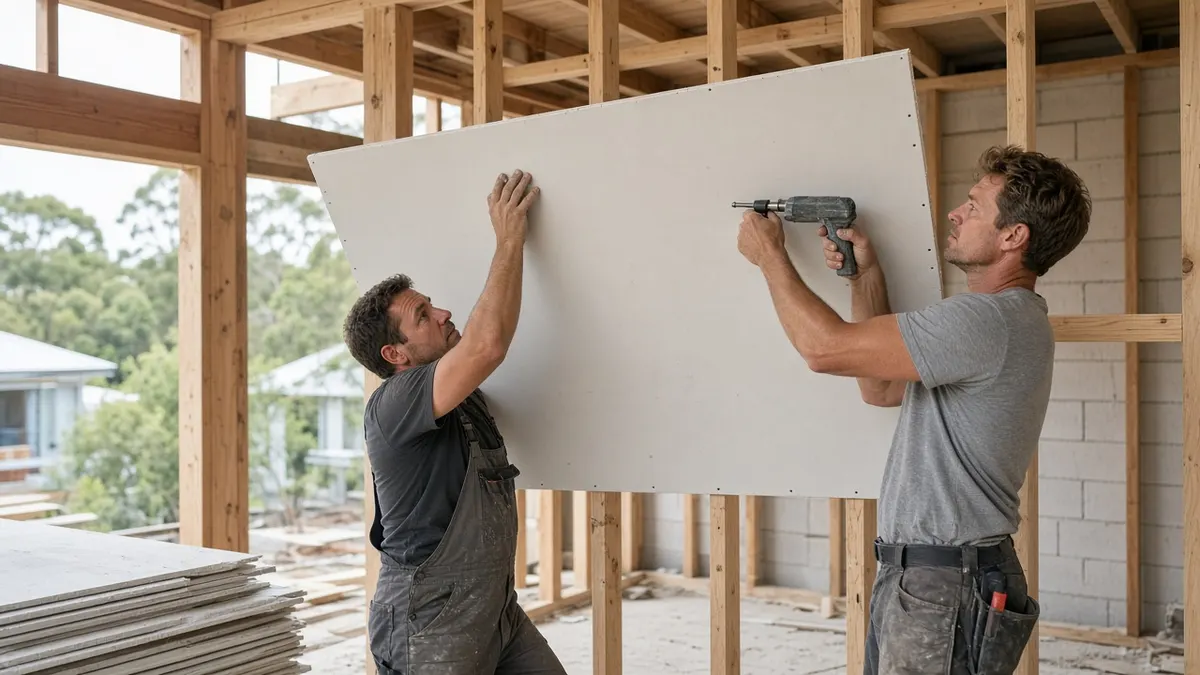
Supplying and installing Gyprock costs between $40 and $90 per m² of wall or ceiling in most of Australia in 2026, with the board hung, joints set and sanded ready for paint. A standard bedroom usually comes to $1,700 to $3,300, and relining a whole three-bedroom house can run from $16,000 to more than $30,000.
Gyprock is a brand of plasterboard made by CSR, but most Australians use the name for any plasterboard, the same way people say Esky. The prices here apply to plasterboard from any major manufacturer. They include GST, are indicative only and assume a standard single-storey home. Get at least three written quotes, and check that each covers the same board, finish and cornice.
Installation prices per m² by board type
The board choice is set partly by the room and partly by the building rules. Wet areas need moisture-resistant board, walls between a garage and the house or between townhouses often need fire-rated systems, and bedrooms near a busy road may benefit from acoustic board.
| Board and location | Supplied, hung and set per m² |
|---|---|
| Standard 10 mm board on walls | $40 to $70 |
| 13 mm board on ceilings | $50 to $90 |
| Wet area (moisture-resistant) board | $50 to $85 |
| Fire-rated board in a tested system | $60 to $100 |
| Acoustic or sound-rated board | $65 to $110 |
| Impact-resistant board for halls and rentals | $60 to $100 |
| Level 5 finish on top of standard setting | Add $10 to $20 |
Ceilings cost more than walls because the work is overhead, the sheets are usually longer and heavier, and they often need a plaster lifter or two people holding each sheet. Raked or cathedral ceilings and anything above 2.7 m add more again because of scaffolding and slower work.
What the board itself costs
Materials are a smaller share of the bill than most people assume. Labour for hanging, setting and sanding is usually 60 to 75 percent of the installed price. These are indicative retail prices.
| Board | Common sheet size | Price per sheet | Approx per m² |
|---|---|---|---|
| Standard 10 mm | 2400 x 1200 | $16 to $28 | $6 to $10 |
| Ceiling 13 mm | 3600 x 1200 | $30 to $50 | $7 to $12 |
| Wet area 10 mm | 2400 x 1200 | $28 to $45 | $10 to $16 |
| Fire-rated 13 or 16 mm | 3600 x 1200 | $40 to $75 | $9 to $17 |
| Acoustic 13 mm | 3600 x 1200 | $50 to $85 | $12 to $20 |
On top of the board, allow roughly $4 to $8 per m² for adhesive, screws, paper tape, base and topping compounds, and corner beads. Cornice adds $3 to $8 per linear metre in material for standard cove profiles.
What an installation price should include
A standard plasterboard price covers fixing the sheets to the frame with adhesive and screws, taping joints, applying three coats of compound to joints and screw heads, fitting corner beads to external corners and sanding everything smooth. The usual target is a Level 4 finish, the standard finish for walls and ceilings that will get flat or low-sheen paint.
Things that are often left out, so check your quote:
- Removing and disposing of old linings, usually $15 to $30 per m².
- Fixing or adding timber or steel battens and noggings.
- Insulation in walls or ceilings.
- Cornice, or a square set junction instead of cornice.
- Cut-outs for downlights, exhaust fans and power points, which are often included but not always.
- Scaffolding for high ceilings and stairwells.
- Priming and painting.
Insulation is worth doing while the walls are open, because adding it later is far harder. Our directory lists insulation installers who can fit batts before the board goes up.
Typical costs by room and project
| Project | Approx board area | Typical cost |
|---|---|---|
| Bedroom, 3 x 3.5 m, walls and ceiling | 38 m² | $1,700 to $3,300 |
| Living room, 5 x 6 m, walls and ceiling | 80 m² | $3,600 to $7,000 |
| Bathroom walls and ceiling, wet area board | 25 m² | $1,300 to $2,500 |
| Replace one room ceiling, 4 x 4 m, including removal | 16 m² | $1,100 to $2,200 |
| Single garage conversion, walls and ceiling | 80 m² | $3,500 to $7,000 |
| Extension of 30 m² floor area | 110 m² | $4,500 to $9,000 |
| Reline whole three-bedroom house | 380 to 450 m² | $16,000 to $35,000 |
To estimate board area yourself, add up the room perimeter, multiply by the ceiling height, subtract roughly 2 m² for each door and window, then add the ceiling area. A 3 x 3.5 m bedroom with 2.4 m ceilings has about 31 m² of wall, less 4 m² for the door and window, plus 10.5 m² of ceiling, which gives the 38 m² in the table.
Cornice or square set
Where the wall meets the ceiling, you have two choices. Cornice is a moulded strip that hides the junction. A standard 75 to 90 mm cove cornice costs about $12 to $25 per linear metre installed and is the cheapest, quickest option. Larger or decorative profiles cost more, and ornate period cornices can run $40 to $120 per linear metre.
Square set means no cornice at all, with a clean, sharp corner made using a plastic or metal stopping bead. It looks modern, but it takes more time and skill to get straight and it shows any movement crack. Expect to pay roughly $15 to $30 per linear metre more than cove cornice, and expect more work on the ceiling finish too, since there is nothing to hide an imperfect edge.
Plasterboard costs around the country
Building styles differ between states, which changes the type of plasterboard work available. In Perth, many homes are double brick with hard-plastered walls, so plasterboard work is mostly ceilings, extensions and renovations. On the east coast, timber and steel-framed homes use plasterboard throughout.
| City or area | Walls and ceilings, per m² | Notes |
|---|---|---|
| Sydney | $50 to $90 | Highest labour rates, access and parking add time |
| Melbourne | $45 to $85 | Busy renovation market, many period homes with lath and plaster |
| Brisbane | $42 to $78 | Lots of Queenslander renovations and under-house build-ins |
| Perth | $45 to $82 | Mostly ceilings and framed extensions |
| Adelaide | $40 to $75 | Lower labour rates |
| Hobart | $42 to $80 | Smaller pool of plasterers, older housing stock |
| Canberra | $48 to $88 | Rates close to Sydney |
| Darwin | $52 to $95 | Freight on board, humid conditions slow drying |
| Regional | $40 to $80 | Travel and board delivery may be charged |
Three worked examples
All totals include GST. Framing, electrical work and painting are excluded unless listed.
Garage conversion in Campbelltown, NSW
A 6 x 5.5 m single garage being turned into a rumpus room. The builder framed the old roller door opening and the electrician did the rough-in. The plasterer quoted the linings.
| Line item | Cost |
|---|---|
| 10 mm board on walls, 50 m² at $48 | $2,400 |
| 13 mm board on ceiling, 33 m² at $58 | $1,914 |
| Cove cornice, 23 linear metres at $15 | $345 |
| Corner beads and sundries | $150 |
| Offcut removal and clean-up | $200 |
| Total (incl GST of about $455) | $5,009 |
About $60 per m² of board. Turning a garage into a habitable room usually needs approval, so check with council or a certifier before you start.
Bathroom reline in a 1960s Geelong weatherboard
The old bathroom linings were stripped for a renovation. A sample was tested for asbestos first and came back clear. Wet area board went on all walls and the ceiling.
| Line item | Cost |
|---|---|
| Asbestos test on old linings | $120 |
| Strip and dispose of old linings | $400 |
| Wet area board, walls and ceiling, 27 m² at $62 | $1,674 |
| Cornice, 8 linear metres at $18 | $144 |
| Total (incl GST of about $213) | $2,338 |
Areas to be tiled only need joints taped and set to a flat finish, not a full paint-ready finish, which helps the price. Waterproofing and tiling come after.
Living room ceiling replacement in a post-war Brisbane home
A 5 x 4.5 m living room with an old ceiling that had sagged between joists. It was tested, removed and replaced with new battens and 13 mm board.
| Line item | Cost |
|---|---|
| Asbestos test | $120 |
| Remove and dispose of old ceiling, 22.5 m² at $18 | $405 |
| New ceiling battens, 22.5 m² at $15 | $338 |
| 13 mm board, hung, set and sanded, 22.5 m² at $60 | $1,350 |
| Cove cornice, 19 linear metres at $16 | $304 |
| Trestles, floor protection and clean-up | $200 |
| Total (incl GST of about $247) | $2,717 |
Ceiling replacement is messy, so the owners moved furniture out and sealed doorways first. If only part of a ceiling has a crack or a hole, a plaster repair is far cheaper than a full replacement.
Older homes: lath and plaster, masonry walls and uneven frames
Pre-war homes in Melbourne, Adelaide, Hobart and inner Sydney often have lath and plaster walls and ceilings: thin timber strips nailed to the frame and covered in a thick coat of lime plaster. Removing it is slow, heavy and extremely dusty, and the waste weighs far more than plasterboard. Budget $25 to $40 per m² for removal and disposal in these homes, plus a skip. Some owners keep the old walls and screw new board over the top, which saves demolition but loses a little room and needs longer screws and careful fixing into the frame.
Masonry walls are a different job again. Plasterboard can be fixed to brick or block using adhesive daubs, or onto steel furring channels screwed to the wall, which creates a cavity for cables and insulation. Furring channel adds roughly $15 to $30 per m² but gives a straighter result on uneven brickwork. Direct stick is cheaper but follows every bow in the wall.
Old timber frames are rarely straight. Studs twist and shrink over decades, and a plasterer may need to plane high spots or pack low ones before hanging board. That time should be in the quote. If a plasterer prices a 1920s bungalow at the same rate as a new project home, ask how they plan to deal with the frame.
Levels of finish and when Level 5 is worth paying for
The Australian and New Zealand standard for plasterboard linings, AS/NZS 2589, sets out levels of finish from 0 to 5. Level 3 is meant for surfaces that will be covered by tiles or heavy texture. Level 4 is the normal finish for most rooms with flat or low-sheen paint. Level 5 adds a thin skim of compound over the entire surface, so the paper and the set joints have the same texture.
Level 5 matters where light hits the wall at a low angle: long hallways with a window at one end, walls beside floor-to-ceiling glass, ceilings with lots of downlights, and anywhere you plan gloss or semi-gloss paint. In those spots, joints that look perfect in normal light can show as faint bands. If your design has those conditions, ask for Level 5 in the quote rather than complaining afterwards. Our plastering cost guide covers setting and skim coating in more detail.
Licences, fire and wet area rules
Plasterboard work is licensed in several states once it passes a value threshold. In NSW, dry plastering, which covers plasterboard, fibre cement sheeting, cornices and suspended ceilings, needs a contractor licence for residential work over $5,000 in labour and materials including GST. The NSW Government dry plastering page sets out the category. In Queensland, the QBCC requires a licence for building work valued over $3,300, explained on its page about when you need a licence. In Victoria, domestic building work over $10,000 generally needs a registered practitioner, so check with the Building and Plumbing Commission. In other states and territories, check with Building and Energy, Consumer and Business Services, CBOS, Access Canberra or the NT Building Practitioners Board.
Fire-rated walls and ceilings must be built exactly as the tested system specifies, including stud spacing, screw spacing, board layers and sealing of penetrations. This applies to walls between a garage and the house in some situations, and to walls between attached dwellings. The National Construction Code sets the requirements, and the manufacturer's system guide shows how to meet them. Do not substitute cheaper board in a fire-rated wall.
In wet areas, the board must be suitable for the location and installed to suit the waterproofing system. Homes built before 1990 may have fibre cement linings containing asbestos in bathrooms, laundries and eaves. Test before removing anything, and use a licensed removalist where required.
DIY hanging or hiring a plasterer
Hanging plasterboard is heavy, awkward work, and setting it well is a true skill. A 13 mm ceiling sheet 3.6 m long can weigh well over 30 kg, so ceilings need two people and ideally a hired plaster lifter, which costs about $40 to $80 a day. Walls are more manageable for a handy owner.
The finishing is where most DIY jobs fall down. Three thin coats of compound, feathered wide and sanded smooth, take practice. Poor setting shows through paint as ridges, bumps and dips, and fixing it means more compound, more sanding and more paint. A common compromise is to hang the board yourself to the plasterer's instructions and pay a plasterer to set and finish, though many plasterers prefer to hang their own board so they can stand behind the result.
How long plasterboard installation takes
A two-person crew can hang a few rooms of walls and ceilings in a day. Setting then needs three coats, each left to dry before the next, so even a small job spreads across three to five days. A whole-house reline often takes two to three weeks. Cold or humid weather slows drying.
Expect dust during sanding, even with vacuum sanders. Seal off doorways, cover floors and take out anything you do not want coated in fine white powder. Painting can usually start once the final sanding is done and the surfaces are dust-free. See the house painting cost guide for typical painting prices.
Lifespan and future maintenance
Plasterboard that stays dry lasts for the life of the house. The common problems later on are hairline cracks at joints and cornices as the frame moves, popped screw heads, dents from furniture and water damage from roof or plumbing leaks. Small cracks and dents are cheap to fix during the next repaint. Water damage needs the leak fixed first, and soaked board usually has to be cut out and replaced rather than dried and patched.
Choosing impact-resistant board in hallways, kids' rooms and rental properties costs a little more up front and saves repairs over time. In bathrooms, a good exhaust fan vented outside protects the ceiling board from years of steam.
Ways to keep plasterboard costs down
- Combine rooms into one job so the crew is not setting up and returning for small areas.
- Do the strip-out of old linings yourself or with labour help, once any asbestos risk is cleared.
- Choose standard cove cornice over square set unless the look really matters to you.
- Use Level 5 only where the lighting calls for it.
- Have electricians and plumbers finish their rough-in before the plasterer arrives, so no one cuts holes in new board.
- Make sure the frame is straight. Plasterers can pack minor problems, but badly out-of-line studs show through.
Reading a plasterboard quote
A good quote states the board type and thickness for each area, the area in square metres, the level of finish, cornice profile or square set, who removes old linings, whether insulation is included, and the expected number of days. It also names the licence number where your state requires one and confirms public liability insurance.
Watch for prices quoted per sheet without a clear scope, quotes that do not mention setting at all, cash-only pricing and large deposits. NSW caps deposits for residential building work at 10 percent, and Victoria at 10 percent for contracts under $20,000 and 5 percent above. For other states, check with your regulator. You can compare tradespeople in our directory of plasterers and Gyprock installers.
Getting labour help through Yakka
Yakka Labour connects you with local workers for the labour-heavy parts of a plasterboard job. That includes stripping old linings once they are cleared of asbestos, carrying sheets from the delivery truck into the house, stacking them where the plasterer wants them, and cleaning up offcuts and dust at the end. Plasterboard is heavy and awkward, and an extra pair of hands on delivery day is good value. Businesses with bigger programs may also want to read about plastering labour hire in Sydney.
Plasterers listed on Yakka can quote the hanging and setting. For fire-rated systems, any structural framing and anything above your state's licence threshold, make sure the person doing the work holds the right licence.
Frequently asked questions
How much does Gyprock cost per m2 to install?
Supplied, hung, set and sanded ready for paint, plasterboard usually costs $40 to $90 per m² in 2026. Standard 10 mm board on walls is at the lower end, and ceilings, wet area, fire-rated and acoustic boards cost more. Removal of old linings, cornice and painting are usually extra.
How much does it cost to plasterboard a room?
A typical 3 x 3.5 m bedroom has about 38 m² of wall and ceiling, so it usually costs $1,700 to $3,300 to line with new plasterboard. Larger living rooms of around 80 m² of board cost $3,600 to $7,000. Prices depend on ceiling height, board type, cornice choice and access.
How much does a Gyprock sheet cost?
A standard 2400 x 1200 mm sheet of 10 mm plasterboard usually costs about $16 to $28 retail. A 3600 x 1200 mm 13 mm ceiling sheet is typically $30 to $50. Wet area, fire-rated and acoustic boards cost more. Adhesive, screws, tape and compound add a few dollars per square metre.
Do I need a licence to install plasterboard?
It depends on the state and the value of the job. In NSW, dry plastering work worth more than $5,000 including labour and materials needs a contractor licence. In Queensland, the QBCC threshold for building work is $3,300. Victoria uses $10,000 for domestic building work. Homeowners can usually work on their own homes within limits.
What is the difference between Gyprock and plasterboard?
Gyprock is a brand name for plasterboard made by CSR. Plasterboard is the general term for gypsum board faced with paper, used for internal walls and ceilings. Other manufacturers make equivalent products, and the installation process and costs are much the same whichever brand you use.
Is square set more expensive than cornice?
Yes. Square set usually costs about $15 to $30 per linear metre more than standard cove cornice because it needs stopping beads, more setting and a higher standard of finish along the junction. It gives a clean, modern look but shows movement cracks more easily than cornice.
How long does it take to install plasterboard?
Hanging a few rooms can take one or two days, but setting needs three coats with drying time between each, so most jobs take three to five days before painting. A full house reline usually takes two to three weeks. Cold or humid weather can slow drying times.
Official sources
Award rates, licences and safety rules change. Check the official source before you hire or take on a shift.
- Queensland Building and Construction Commission (QBCC)Contractor, plumbing and drainage licence search in Queensland
- Consumer and Business Services SALabour hire licensing in South Australia
- Building and Plumbing Commission (Victoria)Builder and plumber registration, domestic building insurance and licence checks in Victoria
- Asbestos Safety and Eradication AgencyWhere asbestos is found in homes and how to deal with it safely
- Consumer, Building and Occupational Services (Tasmania)Building, plumbing and electrical licensing in Tasmania
- Access CanberraConstruction occupation licences and building approvals in the ACT