More cost guide
Plaster Repair Cost in Australia: 2026 Prices for Cracks and Holes
Typical cost in Australia (2026, inc. GST)
$150 to $900 per job
typical single repair such as a hole, crack or small ceiling patch, painting extra
Most plaster repairs in Australia cost $150 to $900 per job in 2026. Patching a small hole or a hairline crack usually costs $150 to $350, a larger patch up to 1 m² costs $350 to $700, and a water-damaged ceiling section $500 to $1,200. Minimum call-out charges, the number of return visits for drying, and repainting the repaired wall are the main drivers of the final price.
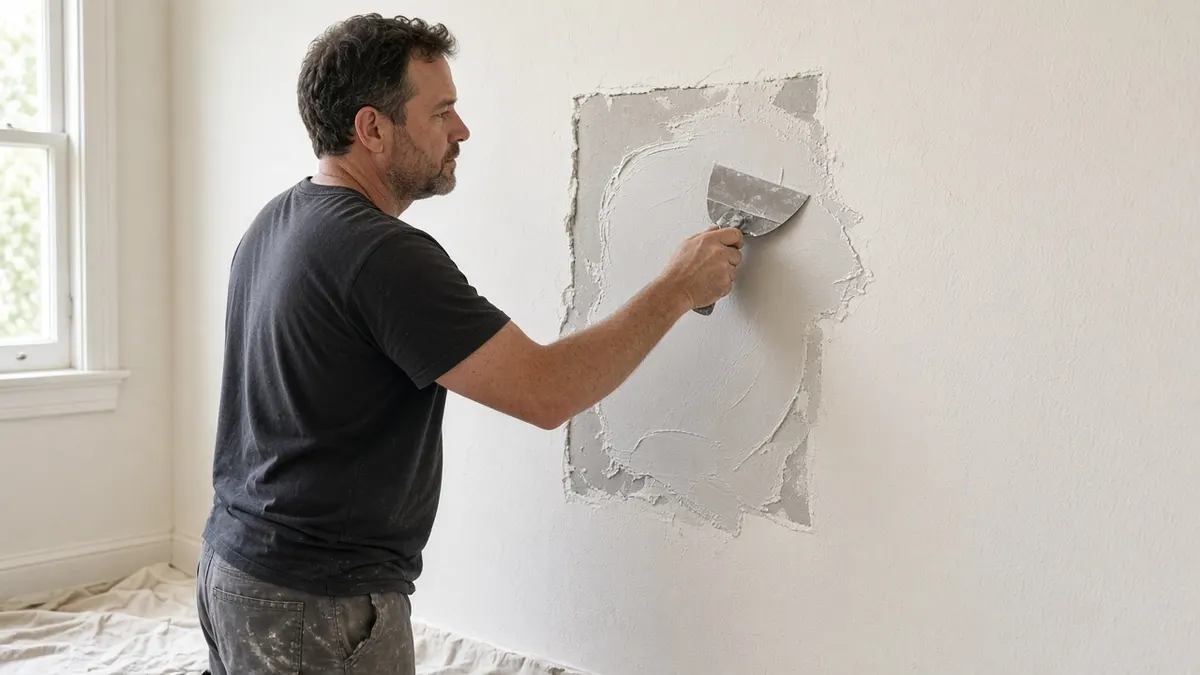
Plaster repairs usually cost $150 to $900 per job in Australia in 2026. A doorknob hole or a few cracks at the cornice sits at the bottom of that range, while cutting out and replacing a water-damaged section of ceiling sits at the top. Replacing a whole ceiling costs more, typically $1,100 to $2,500 per room.
Prices in this guide include GST and are indicative only. Repair work is quoted on what the plasterer sees, so photos help, but an on-site look gives the most reliable price. Get at least three written quotes for anything bigger than a small patch.
Plaster repair prices at a glance
| Repair | Typical cost (incl GST) |
|---|---|
| Screw or nail pops, several in one room | $150 to $300 |
| Small hole up to fist size | $150 to $300 |
| Medium hole up to about 300 mm | $200 to $400 |
| Large hole or cut-out patch up to 1 m² | $350 to $700 |
| Single hairline crack up to 2 m | $150 to $350 |
| Cornice cracks around a whole room | $250 to $600 |
| Re-fix or replace a short length of cornice | $200 to $500 |
| Ornate cornice repair | $300 to $1,000 or more |
| Water-damaged ceiling section up to 2 m² | $500 to $1,200 |
| Re-fix a sagging ceiling, per room | $400 to $1,200 |
| Replace a whole ceiling, per room | $1,100 to $2,500 |
| Patch blown solid plaster up to 1 m² | $250 to $600 |
| Lath and plaster ceiling section | $500 to $1,500 |
These prices cover the plastering. Most repairs also need painting afterwards, which is often the part that decides whether the repair disappears or stands out. Painting is usually a separate line, and it is covered further down.
Why minimum charges dominate small repairs
A tradesperson coming to patch one hole still has to drive there, park, set up drop sheets, mix compound and clean up. That is why most charge a minimum of $150 to $250 for a visit. A traditional patch also needs two or three coats with drying time between them, which can mean coming back on separate days.
Many repairers now use quick-setting compounds that let them apply several coats in one visit, which keeps the cost of small jobs down. Others stack several clients' jobs into a route and return for the final coat later in the week. Either way, the cheapest way to fix small damage is to batch it: save up the holes, cracks and dents around the house and get them done in one booking.
Handyman or plasterer
For small holes, screw pops and minor cracks before a repaint, a capable handyman is often the cheapest option. Handyman rates are typically $70 to $110 an hour, and our post on handyman hourly rates in Australia covers them in more detail. Plasterers usually charge $60 to $100 an hour plus a minimum, and they are the better choice for anything larger or more visible.
Call a plasterer for patches bigger than a dinner plate, ceilings, cornices, water damage, recurring cracks, solid plaster and any wall that will be in strong light. Setting compound over a large area so it is invisible under paint is a skill that shows. You can find both through our directories of plasterers and handymen near you.
Cracks: cosmetic or a warning sign
Most cracks in plaster are cosmetic. Hairline cracks along cornices, at sheet joints and in the corners of rooms usually come from normal movement as timber frames dry, as temperatures change and as clay soils swell and shrink with the seasons. They are cheap to fix and commonly reappear in a softer form, which is why many plasterers use flexible fillers at cornices.
Some cracks deserve a closer look before anyone patches them:
- Diagonal cracks running from the corners of doors and windows, especially if they are wider at one end.
- Cracks wider than a few millimetres, or ones that keep growing after being patched.
- Doors and windows that start to stick or no longer latch.
- Matching cracks in external brickwork or the slab.
- Floors that feel out of level.
These can point to footing movement, poor drainage, leaking pipes under the house or tree roots drawing moisture from clay. Patching the plaster without dealing with the cause wastes money. A simple trick is to pencil a line across each end of a crack with the date, then check it over a few months. If it grows, get a professional opinion. Our structural engineer cost guide covers inspection fees.
Water damage: fix the leak first
Brown rings, bubbling paint, soft spots and sagging in a ceiling almost always mean water. Common sources are roof leaks, blocked gutters overflowing into the roof space, leaking showers or pipes in a bathroom above, hot water systems in the roof, and air conditioner condensate lines.
Repairing the plaster before the leak is fixed is a waste of money, since the stain will come straight back. Find and fix the source first: a plumber for pipes and showers, a roofer for the roof. Our roof leak repair cost guide covers what that typically costs. Then let the area dry out fully before the plasterer starts.
Plasterboard that has been soaked loses strength and usually needs cutting out and replacing rather than drying and patching. A ceiling that is heavy with water can collapse without much warning, so if you see a bulge, keep people out of the room and get it checked quickly. Water damage from a sudden event may be covered by home insurance, so check your policy and take photos before anything is removed.
Sagging and collapsing ceilings
Older plasterboard ceilings, particularly in homes from the 1960s to the 1980s, can sag as the adhesive holding the sheets to the battens fails over time. Signs include a visible dip between ceiling joists, cracks along sheet joins, gaps opening between the cornice and the wall, and a ceiling that moves when you push on it gently.
A ceiling that is starting to sag can often be re-fixed with screws and new adhesive, sometimes with extra battens, for $400 to $1,200 per room. Once it has dropped significantly or the board is cracked through, replacement is usually the better choice, at $1,100 to $2,500 per room. Do not wait on a sagging ceiling. Plasterboard is heavy, and a full sheet coming down is dangerous.
Lath and plaster ceilings in older homes fail differently. The plaster loses its grip on the timber laths and comes away in heavy chunks. Small sections can be secured and patched by a plasterer who knows heritage work. Large areas are usually replaced with plasterboard, often keeping the original cornice and ceiling rose where possible.
Repair costs around the country
Small-job prices follow local labour rates and travel times. The first column below is a typical price for a single small repair such as a fist-sized hole, patched and primed ready for paint.
| City or area | Single small repair | Plasterer hourly rate |
|---|---|---|
| Sydney | $200 to $400 | $70 to $100 |
| Melbourne | $180 to $380 | $65 to $95 |
| Brisbane | $170 to $350 | $60 to $90 |
| Perth | $180 to $380 | $65 to $95 |
| Adelaide | $150 to $320 | $55 to $85 |
| Hobart | $160 to $340 | $55 to $85 |
| Canberra | $190 to $390 | $65 to $95 |
| Darwin | $220 to $450 | $75 to $105 |
| Regional | $150 to $350 | $55 to $90 |
In Perth, more homes have solid plaster on brick, and repairs there are priced a little differently from plasterboard patches. Blown or drummy solid plaster has to be hacked off back to sound material and re-plastered.
Three worked examples
All totals include GST.
End-of-lease patching in a Footscray unit
A tenant moving out of a two-bedroom unit with four picture hook holes, a doorknob hole behind the bedroom door and two screw pops. The repairs were done over two short visits, and a painter touched up the affected walls.
| Line item | Cost |
|---|---|
| Call-out and first hour | $160 |
| Additional 2.5 hours over two visits at $85 | $213 |
| Compound, patches and primer | $35 |
| Repaint three affected walls | $380 |
| Total (incl GST of about $72) | $788 |
Painting whole walls rather than dabbing over the patches is what made the repairs invisible at the final inspection.
Water-damaged hallway ceiling in Newcastle
A storm opened a gap in old ridge capping on a 1950s home, and water stained and softened a 1.5 m² section of hallway ceiling.
| Line item | Cost |
|---|---|
| Roof repair by a roof plumber | $450 |
| Cut out damaged board, fit backing battens and new board, set in three coats | $650 |
| Stain-blocking sealer and repaint the hallway ceiling | $420 |
| Total (incl GST of about $138) | $1,520 |
The stain-blocking sealer matters. Water stains bleed through ordinary ceiling paint within weeks.
Seasonal cracking in an Adelaide home on clay
A 1970s brick veneer with cornice cracks in three rooms and a diagonal crack above the hallway door. The owners got an engineer to check the house before spending money on cosmetic repairs.
| Line item | Cost |
|---|---|
| Structural engineer inspection and report | $700 |
| Rake out and flexibly fill cornice cracks, 30 linear metres at $15 | $450 |
| Diagonal crack above door, mesh tape and set | $280 |
| Prime and repaint the repaired walls and cornices | $650 |
| Total (incl GST of about $189) | $2,080 |
The engineer found normal seasonal movement and recommended fixing a leaking downpipe that was wetting the soil near the footings. That cheap fix reduced the cracking the next year.
What happens on a repair visit
For a small patch, the repairer cuts back any loose paper or crumbly edges, fixes a backing piece or mesh patch behind larger holes, then applies the first coat of compound. With quick-set products, a second and third coat can follow within an hour or two, and the area is sanded and primed the same day. With standard compounds, expect a second visit a day or two later.
For ceiling sections, the damaged board is cut back to the nearest joists or battens so the new piece has something solid to screw into. The joints are then taped and set like new work, which means two or three visits over several days. Expect some dust and drop sheets on the floor, and plan to keep the room clear until the painter has finished.
Most small repairs take one to three hours of actual work. Ceiling replacements in a single room usually run over three to five days, including drying time, before painting.
Tenants, landlords and sellers
Plaster damage comes up constantly at the end of a lease. Tenancy laws in each state separate fair wear and tear from damage. Small marks and minor settlement cracks are usually treated as wear and tear, while doorknob holes, large picture hook holes and impact damage are usually the tenant's responsibility. Check your lease and your state tenancy authority's guidance, and photograph the walls at the start and end of the tenancy.
If you are a tenant repairing before you leave, use a professional for anything visible. A lumpy patch can cost more in bond deductions than doing it properly. Landlords often find it cheaper to book one repair visit and a repaint between tenancies than to argue over each hole.
Sellers should fix obvious cracks and water stains before listing. A building inspector will note them, and buyers often assume the worst about a stained ceiling. Fixing a known leak and repairing the ceiling, with receipts to show, takes that worry off the table.
Matching the paint after a repair
The repair is only half the job. Fresh compound absorbs paint differently from the old wall, so a patch that is only touched up often shows as a duller or shinier square, a problem called flashing. Even with the original colour, older paint has faded and the new coat will look different.
The reliable approach is to prime the repair, then repaint the whole wall from corner to corner, or the whole ceiling. Painting one wall typically costs $200 to $500 depending on size and height. If several rooms need repairs, it can make sense to fold them into a repaint. Our house painting cost guide covers room and whole-house prices.
Asbestos and lead in older homes
In homes built before 1990, some wall and ceiling linings, particularly in bathrooms, laundries, eaves and sleep-outs, may be fibre cement sheeting containing asbestos. Some textured or sprayed ceiling finishes from that era can also contain it. Drilling, cutting or sanding these materials releases fibres. If you are not sure what a wall or ceiling is made of, have a sample tested before work starts. A lab test typically costs $80 to $150.
The Asbestos Safety and Eradication Agency explains where asbestos is found in homes and how to deal with it safely. Removal of larger areas needs a licensed asbestos removalist. Paint in homes built before about 1970 may contain lead, so sanding old paint around a repair also needs care.
DIY repairs: what is realistic
Small holes and hairline cracks are fair DIY territory. A patch kit and a tub of ready-mixed compound cost $15 to $40 at a hardware store. The skill is in applying thin coats, feathering them wide past the damage, and sanding lightly. Most DIY patches fail by being too thick, too small or sanded through to the paper.
Leave these to a professional: ceilings, anything larger than about 300 mm, water-damaged board, cornices, solid plaster, recurring cracks, and any material that might contain asbestos. Ceiling work involves working overhead on a ladder with heavy board, and a falling sheet can injure you.
Ways to keep repair costs down
- Batch every hole, crack and dent in the house into one booking to spread the minimum charge.
- Clear furniture away from the walls and lay your own drop sheets before the repairer arrives.
- Keep leftover paint from the last repaint, labelled with the room and colour code.
- Fix leaks, gutters and downpipes promptly so small water stains do not become ceiling replacements.
- Book repairs just before a planned repaint, so the painter covers the patches in the normal course of work.
Stopping the damage coming back
Door stops are the cheapest plaster protection there is. A $10 stop on the skirting or floor prevents most doorknob holes. Use proper wall anchors or picture rail hooks for heavy mirrors and art rather than nails straight into the board. In bathrooms, run the exhaust fan during and after showers so the ceiling does not stay damp for hours every day.
For cracks, the long-term fixes are outside the house: keep gutters and downpipes clear and connected, stop garden beds and sprinklers from soaking the soil against the footings, and manage large trees close to the house on clay soils. These steps cost little and reduce the seasonal movement that cracks plaster in the first place.
Do repairers need a licence?
Most plaster repairs fall well under licensing thresholds. In NSW, a contractor licence is needed for residential building or trade work valued at more than $5,000 including labour and materials, and dry plastering is its own category, explained on the NSW Government dry plastering page. In Queensland, the QBCC threshold for building work is $3,300. Victoria uses $10,000 for domestic building work, so check details with the Building and Plumbing Commission. Other states set their own rules through Building and Energy, Consumer and Business Services, CBOS and Access Canberra. A whole-house repair and ceiling replacement can easily pass these thresholds, so check before you sign.
What to ask before you book
- Is the price a fixed quote or hourly, and is there a minimum charge?
- How many visits will it take, and on which days?
- Does the price include priming, or will the area be left bare for the painter?
- For water damage, will the board be replaced or patched?
- For cracks, what filler will be used, and is there any warranty if they reopen?
- Do you have public liability insurance?
- For larger jobs, what is your licence number?
Be wary of anyone who wants full payment up front for a small repair, or who suggests patching over a fresh water stain without checking for a leak. If you want a broader view of new plastering work rather than repairs, see our plastering cost guide.
Getting help through Yakka
Yakka Labour connects people with local workers by the job, including handymen who can handle small plaster patches and the prep around them. For larger repairs, extra hands help with moving furniture, laying protection, carrying out damaged board and cleaning up the dust afterwards.
For ceiling replacements, recurring structural cracks and anything that may contain asbestos, use the right professionals: a plasterer for the linings, an engineer or building inspector for structural questions, and a licensed removalist where asbestos is involved.
Frequently asked questions
How much does it cost to fix a hole in plaster?
A small hole up to fist size usually costs $150 to $300 to repair, mostly because of minimum call-out charges. Medium holes up to about 300 mm cost $200 to $400, and larger patches up to 1 m² cost $350 to $700. Repainting the wall afterwards is usually extra and is what makes the patch invisible.
How much does it cost to repair a water-damaged ceiling?
Replacing a water-damaged section of ceiling up to about 2 m² usually costs $500 to $1,200, including new board and setting. A whole ceiling in one room typically costs $1,100 to $2,500. The leak must be fixed first, and a stain-blocking sealer is needed before repainting so the stain does not bleed through.
Are cracks in plaster walls serious?
Most hairline cracks at cornices and joints are cosmetic and come from normal seasonal movement. Wide cracks, diagonal cracks from door and window corners, cracks that keep growing, sticking doors and matching cracks in brickwork can signal footing or drainage problems. In those cases, get a structural engineer or building inspector to check before repairing.
Should I use a handyman or a plasterer for repairs?
A handyman is usually fine for small holes, screw pops and minor cracks, especially if they are doing other jobs at the same time. Use a plasterer for ceilings, cornices, patches larger than a dinner plate, water damage, solid plaster and walls in strong light, where the finish needs to be invisible under paint.
How much does it cost to fix a sagging ceiling?
If caught early, a sagging plasterboard ceiling can often be re-fixed with screws, adhesive and extra battens for $400 to $1,200 per room. If the board has dropped badly or cracked, replacement usually costs $1,100 to $2,500 per room. Keep people out of the room until it is checked, as ceilings can collapse.
Can I patch plaster myself?
Small holes and hairline cracks are manageable with a patch kit and ready-mixed compound costing $15 to $40. Apply thin coats, feather them wide and sand gently. Leave ceilings, large holes, water damage, cornices and any material that might contain asbestos to a professional.
Does home insurance cover plaster repairs?
Insurance may cover plaster damage caused by a sudden event such as a storm or burst pipe, depending on your policy. Gradual damage from long-term leaks, wear and normal settlement cracking is usually excluded. Take photos before anything is removed and contact your insurer before starting repairs.
Official sources
Award rates, licences and safety rules change. Check the official source before you hire or take on a shift.
- Queensland Building and Construction Commission (QBCC)Contractor, plumbing and drainage licence search in Queensland
- Consumer and Business Services SALabour hire licensing in South Australia
- Building and Plumbing Commission (Victoria)Builder and plumber registration, domestic building insurance and licence checks in Victoria
- Asbestos Safety and Eradication AgencyWhere asbestos is found in homes and how to deal with it safely
- Consumer, Building and Occupational Services (Tasmania)Building, plumbing and electrical licensing in Tasmania
- Access CanberraConstruction occupation licences and building approvals in the ACT