Rates
Carpenter Hourly Rate Australia (2026): What to Pay
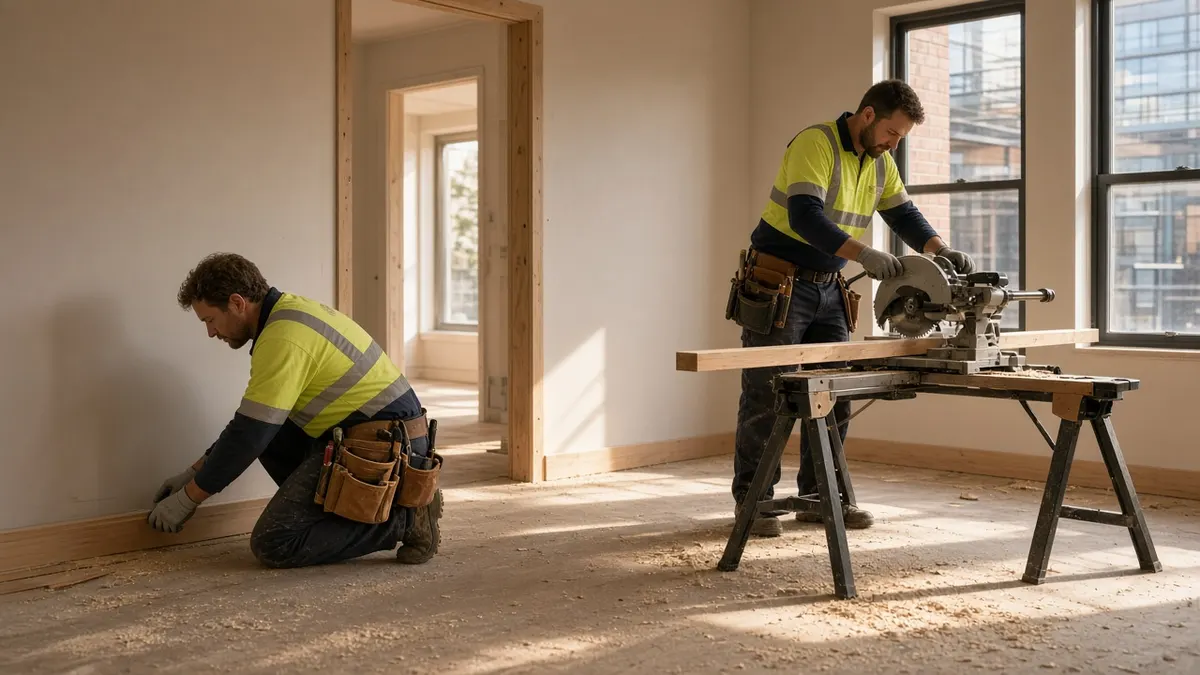
The carpenter hourly rate in Australia in 2026 is typically $48–68/hr for a qualified carpenter employed on a casual basis, $40–50/hr for a carpenter labourer and $55–75/hr for a formwork carpenter on commercial sites. Homeowners hiring a carpentry business pay a charge-out rate of roughly $75–120/hr. These are indicative market observations; confirm award minimums on Fair Work.
Three different numbers get called "the carpenter rate", and mixing them up is how budgets go wrong. This guide separates them, gives city bands, explains what pushes a rate up or down, and walks through a costed fix-out. Yakka Labour is the hiring marketplace, not the workwear brand with a similar name.
Is the carpenter rate a wage, a charge-out rate or a labour-hire rate?
| Rate type | Who pays it | Indicative 2026 band | What it covers |
|---|---|---|---|
| Employee wage (casual) | Builder or contractor to their carpenter | $48–68/hr | Wage including casual loading; super and workers comp on top |
| ABN labour-only rate | Builder to a subcontract carpenter | $55–80/hr or $450–650/day | Labour, own tools and ute, insurance, admin |
| Business charge-out rate | Homeowner to a carpentry business | $75–120/hr | Wage, super, insurance, vehicle, overheads and margin |
| Agency labour-hire rate | Builder to a labour hire agency | Above the wage band | Wage plus the agency's on-costs and margin |
If you are a homeowner comparing quotes, compare charge-out rates. If you are a builder adding hands, compare wages or labour-only rates. On Yakka Labour you agree the rate directly with the carpenter and pay through the platform, without an agency margin on top.
What is the carpenter hourly rate in Sydney, Melbourne, Brisbane, Perth and Adelaide?
| City | Casual qualified carpenter (AUD/hr) | Day rate, 8 hours (AUD) | Business charge-out (AUD/hr) |
|---|---|---|---|
| Sydney | $52–70 | $416–560 | $85–120 |
| Melbourne | $50–68 | $400–544 | $80–115 |
| Brisbane | $48–66 | $384–528 | $75–110 |
| Perth | $50–70 | $400–560 | $80–115 |
| Adelaide | $45–62 | $360–496 | $70–100 |
| Regional centres | $42–58 | $336–464 | $65–95 |
All figures are indicative 2026 market observations. Inner-city commercial sites, high-rise and projects under an enterprise agreement sit at or above the top of each band.
What drives a carpenter's hourly rate?
- Type of carpentry. Framing carpenters on house lots are often paid by the day or by the frame. Fit-out and fix-out carpenters (doors, skirting, architraves, stairs, cabinetry install) earn similar hourly rates but are judged on finish quality. Formwork carpenters on commercial jobs usually earn the most because of the pace, heights and responsibility for the pour.
- Tools and vehicle. A carpenter who brings a ute, nail guns, a drop saw and a compressor is worth more per hour than one who needs everything supplied.
- Tickets. A white card is the minimum. Working at heights, EWP and forklift tickets add value on commercial sites.
- Site type. Residential work, commercial fit-out and civil formwork have different pay norms, allowances and agreements.
- Timing. Short-notice starts, weekend work and lock-up deadlines push rates up.
| Carpentry type | Common pay basis | Indicative casual band (AUD/hr) |
|---|---|---|
| Framing (house lots) | Hourly, daily or per frame | $48–66 |
| Fit-out and fix-out | Hourly or per stage | $48–68 |
| Formwork (commercial) | Hourly, often under a site agreement | $55–75 |
| Maintenance and repairs | Hourly with a minimum charge | $48–62 |
Why does a $55-an-hour carpenter become a $90-an-hour charge-out rate? The business adds super at 12%, workers comp and public liability premiums, the ute, fuel and tools, plus the hours nobody pays for: quoting, travel between jobs, picking up materials and rain days. A healthy business also needs a margin. Charge-out rates that look high next to the wage band usually reflect those costs rather than profit alone.
What is the award rate for a carpenter?
Carpenters working on site are covered by the Building and Construction General On-site Award (MA000020), which Fair Work lists as covering tradespersons including carpenters and their apprentices. A qualified carpenter is usually classified at CW/ECW 3. From 1 July 2026 the base minimum hourly rate for CW/ECW 3 is $29.45 (clause 19.1 of the award text).
That base figure is not the take-home rate. The award adds an industry allowance ($67.15 a week for general building and construction, $53.72 a week for residential, from 1 July 2026), a tool allowance for tradespeople and other allowances, then the 25% casual loading for casuals. The Fair Work pay guide does the full calculation. Market rates sit well above the award, but the award is the legal floor.
How much is an apprentice carpenter paid per hour?
Apprentice carpenter wages under the award are set as a percentage of the tradesperson rate. The percentage rises each year of the apprenticeship and differs for adult apprentices and those who completed Year 12. Rather than rely on a figure from a forum, look up the apprentice table in the Building and Construction award pay guide. Many builders pay above the minimum to keep good apprentices, particularly in the third and fourth years.
For hirers, an apprentice is not cheap labour to be left alone on site. Apprentices need supervision by a qualified carpenter, time off for trade school and structured training. Budget the supervising carpenter's time as part of the real cost, and check whether government apprentice incentives apply to your business before you sign a training contract.
What do carpenters charge per day on an ABN?
Labour-only subcontract carpenters commonly quote $450–650 a day in 2026, higher for formwork leading hands and specialist stair or cabinetry work. Before you engage one, check two things. First, is the arrangement genuine contracting, or is this person really working as your employee? Second, the ATO says contractors paid mainly for their labour are eligible for super guarantee on the labour component, even with an ABN. In NSW, a contractor licence is needed for residential building or trade work, including carpentry, valued at more than $5,000 in labour and materials including GST (NSW carpentry licence rules).
What does a carpentry fix-out cost? A worked example
A builder in Craigieburn needs a double-storey fix-out done in a week: doors, skirting, architraves, wardrobe shelving and stair balustrade.
- 2 qualified carpenters × 5 days × 8 hours × $55/hr = $4,400
- 1 carpenter labourer × 5 days × 8 hours × $42/hr = $1,680
- Wages total: $6,080, before super at 12% (about $730) and workers comp
The same week through a business charging $85/hr per carpenter and $55/hr for the labourer would be about $9,000, which includes the business's insurance, vehicles and margin. Neither is wrong; they buy different things. For the classification side of employing carpenters, see the building and construction award levels guide, and for labourer costs see the labourer day rate breakdown.
How do you hire a carpenter on Yakka?
Before you book, check the basics: a current white card for site work, photos of similar jobs, references from builders they have worked for, and a contractor licence on the state register if they are quoting residential work over the threshold. For ABN carpenters, also ask for a public liability certificate.
- Post the job: suburb, type of carpentry (framing, fit-out, formwork), start date, tickets and your hourly or day rate.
- Browse carpenter profiles near the site and check tickets, tools and photos of past work.
- Message shortlisted carpenters, agree scope, hours and rate in writing.
- Pay through the platform when the work is done.
Sydney builders can also read carpentry labour hire Sydney for local bands, or browse carpenters by area.
Frequently asked questions
Do carpenters charge for travel time?
Many carpentry businesses build travel into their charge-out rate or add a call-out fee for jobs outside their usual area. Employed carpenters may be entitled to fares and travel allowances under the Building and Construction award. For short jobs, ask whether the quote includes travel, parking and material pick-ups so you are comparing like with like.
How much do carpenters charge for small jobs?
Small jobs such as hanging a door or fixing a gate are often priced with a minimum charge, commonly one to two hours at the business charge-out rate, plus materials. In 2026 that typically means $150–300 for a short visit, as an indicative market observation. Grouping several small jobs into one visit usually lowers the cost per task.
Is it cheaper to pay a carpenter by the hour or by the job?
Hourly suits jobs with unclear scope, such as repairs where rot may be hidden. A fixed price suits well-defined work like a deck or a fix-out with a clear plan, because the carpenter carries the risk of overruns. Ask for both on larger jobs and compare the assumptions each quote makes about hours and materials.
Are carpenters paid more for weekend work?
Employed carpenters under the Building and Construction award receive penalty rates for Saturday and Sunday work, and casuals get those penalties with the casual loading built in. Subcontract carpenters set their own weekend rates and commonly charge a premium. Confirm the exact award percentages in the Fair Work pay guide before agreeing weekend pay.
Do I need a licensed carpenter to hang doors?
It depends on the state and the value of the job. In NSW, a contractor licence is needed for residential carpentry worth more than $5,000 including labour, materials and GST. In Queensland, QBCC says a licence is needed for building work valued over $3,300. Small door jobs under those thresholds generally do not need a licensed contractor.
Official sources
Award rates, licences and safety rules change. Check the official source before you hire or take on a shift.
- Fair Work Ombudsman — pay guidesMinimum award rates, casual loading and penalty rates
- Fair Work Pay CalculatorWork out the minimum pay for a specific award and shift
- Safe Work AustraliaNational work health and safety framework, including high-risk work licences
- Queensland Building and Construction Commission (QBCC)Contractor, plumbing and drainage licence search in Queensland
- Australian Taxation Office — super for employersSuperannuation guarantee obligations when you pay workers