Careers
How to Become a Scaffolder in Australia (2026 Guide)
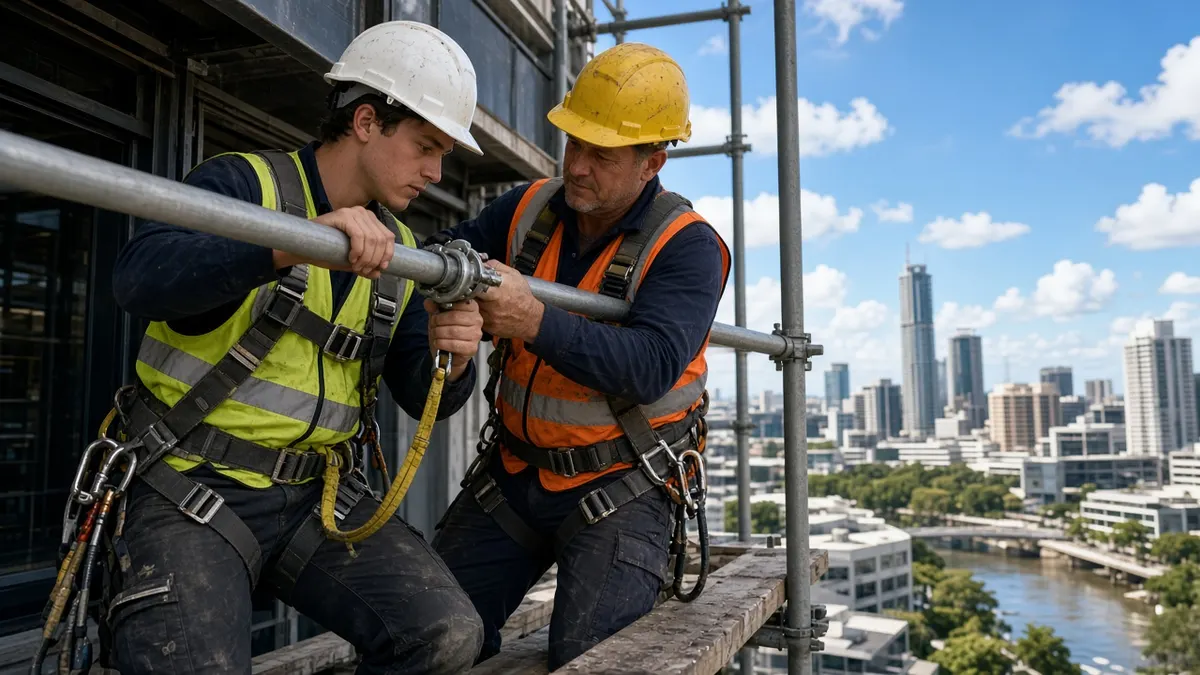
To become a scaffolder in Australia you need a white card, then training with a registered training organisation and an accredited assessment for a high risk work licence in basic scaffolding (SB). Most people start as scaffold labourers, then add intermediate (SI) and advanced (SA) classes. You must be 18, and the licence lasts five years.
This guide walks through the licence classes, what training costs, whether you need a logbook, what scaffolders earn and how the career usually progresses. Yakka Labour is the hiring marketplace, not the workwear brand with a similar name. General information, not legal advice. Check the rules with your state regulator before you enrol.
What licence do you need to be a scaffolder?
Under the WHS laws, scaffolding work means erecting, altering or dismantling a temporary structure that supports a platform from which a person or object could fall more than 4 metres. That work needs a high risk work licence with the right class, whether the job is residential, commercial or industrial. There are three classes:
| Class | Unit of competency | What it covers |
|---|---|---|
| Basic scaffolding (SB) | CPCCLSF2001 | Modular or prefabricated scaffolds, cantilevered materials hoists up to 500 kg, ropes and gin wheels, safety nets and static lines, bracket scaffolds (tank and formwork) |
| Intermediate scaffolding (SI) | CPCCLSF3001 | All basic work plus cantilevered crane loading platforms, cantilevered and spurred scaffolds, barrow ramps, perimeter safety screens and shutters, mast climbers, tube and coupler scaffolds |
| Advanced scaffolding (SA) | CPCCLSF4001 | All intermediate work plus cantilevered hoists, hung scaffolds and suspended scaffolds |
Class descriptions come from SafeWork NSW's high risk work licence page, and all three units are current on training.gov.au. To apply you must be at least 18, finish training with an RTO, be assessed as competent by an accredited assessor and speak enough English to work safely with others.
What does a scaffolder do on a typical day?
A residential scaffolding crew in western Sydney might start at 6:30 am at the yard in Wetherill Park, load a truck with modular frames, standards, ledgers, transoms, planks and toe boards, then drive to a two-storey build in Box Hill. The leading hand checks the plan and ground conditions, the crew lays sole boards and base plates, and the bays go up lift by lift with ties into the structure. Labourers pass gear and stack materials. Licensed scaffolders fix components, install edge protection and check each lift against the design. Before handover the scaffold is inspected and tagged. Afternoons often mean an alteration on another site, a dismantle, or loading the truck for tomorrow. The work rewards people who are organised, careful with sequence and comfortable at height in all weather.
Can you work on scaffolding before you have a licence?
Yes, within limits. A trainee can do licensed scaffolding work while training towards the licence if a licence holder supervises them. Many people start as scaffold labourers: carrying tube, boards and fittings, loading trucks, passing gear up the bay and cleaning the yard. That work builds the experience assessors and employers want to see.
Below the 4 metre threshold a licence isn't legally required, but the hirer still has to make sure workers are trained and the scaffold is safe. CPCCCM2010 (work safely on scaffolding higher than two metres) is a common short course for trades who use scaffolds without building them.
How much does scaffolding training cost?
Course fees are set by each RTO and vary with state funding. These are indicative 2026 market observations from published RTO prices:
- Basic scaffolding (SB): roughly $900–1,600 at full fee, usually four to five days. One Queensland provider lists $1,450 full fee for a five-day course, with much lower funded and concession prices for eligible students.
- Intermediate scaffolding (SI): roughly $1,000–1,600, about four days. The same provider lists $1,200.
- Advanced scaffolding (SA): similar or higher. Fewer RTOs run it, so expect waiting lists.
Then there's the licence fee. For 2026–27 SafeWork NSW charges $95 per class for a new licence and $88 to renew. WorkSafe Victoria lists $77.70 per class and $58.70 to renew. Other states publish their fees on their regulator sites.
Do you need a logbook to become a scaffolder?
SafeWork NSW's eligibility list for a high risk work licence covers age, RTO training, an accredited assessment and English. It doesn't include a logbook. Some RTOs and employers still ask for a record of supervised hours before you enrol in the higher classes, so keep one anyway: dates, site addresses, scaffold types, heights and the licensed supervisor's name and number. It makes the jump to intermediate and advanced much easier to justify.
Steps to get the licence once you're trained
- Get your white card first. You can't work on a construction site without one. See what is a white card.
- Enrol with an RTO approved to deliver high risk work training in your state.
- Sit the assessment. In NSW a SafeWork-accredited assessor at the RTO assesses you and you receive a Notice of Satisfactory Assessment.
- Apply within 60 days. In NSW you apply online through MyServiceNSW and can work on the notice or digital licence while the card is posted.
- Renew every five years. NSW and Victoria allow renewal up to 12 months after expiry. After that you retrain and reapply.
Your licence must be issued by the state you normally live in, but it's recognised across Australia.
What do scaffolders earn?
Pay rises with each class and with the type of site. As indicative 2026 market observations, scaffold labourers commonly see $35–45/hr, basic-ticketed scaffolders $40–52/hr and intermediate or advanced scaffolders $48–65/hr, with higher rates on commercial and enterprise agreement sites. Our scaffolder day rate guide covers day rates and per-square-metre pricing. Most on-site scaffolding employment falls under the Building and Construction General On-site Award, so confirm minimums on the Fair Work pay guides.
What does the scaffolder career path look like?
A typical path runs from scaffold labourer to basic, then intermediate within a year or two, then advanced and leading hand. Some people take the formal route through the Certificate III in Scaffolding (CPC30920) as an apprenticeship. Others add rigging and dogging classes so they can sling and direct loads on commercial jobs, or move into supervision, scaffold inspection or estimating. Experienced advanced scaffolders are sought after on high-rise jobs in Sydney, Melbourne and Brisbane, and on shutdown and resources work in WA and Queensland.
How to find scaffolding work on Yakka
Add your white card, licence classes and suburb to a free worker profile in the Yakka app, and say whether you are a scaffold labourer or licensed. Builders and scaffolding contractors post jobs with start times, required classes and an AUD rate, and message workers directly. Yakka is a marketplace, not an employer, so the hirer and worker agree the engagement. If you are hiring in Sydney, see scaffolding labour hire in Sydney, or browse scaffolding workers.
Frequently asked questions
How long does a basic scaffolding course take?
Most RTOs run basic scaffolding (CPCCLSF2001) over four to five days, including theory, practical work on modular scaffolds and the assessment. After you pass, you apply to your state regulator for the licence. In NSW that must happen within 60 days of your Notice of Satisfactory Assessment. Course length varies by provider, so check the timetable before you book leave from work.
Can I go straight to an intermediate scaffolding licence?
In practice, rarely. The intermediate class covers all basic scaffolding work plus more complex scaffolds, and most RTOs require you to hold basic scaffolding before enrolling in CPCCLSF3001. Employers also want to see time on the tools at basic level first. Plan on working as a basic scaffolder for a while and keep a record of the scaffolds you build.
Is a scaffolding licence valid in every state?
Yes. High risk work licences are recognised across Australia, so a scaffolding licence issued in one state can be used on sites interstate. The licence must be issued by the state or territory you normally live in, and if you move permanently you transfer it to your new home state. Always carry the licence or a digital copy on site.
What happens if my scaffolding licence expires?
You cannot do licensed scaffolding work on an expired licence. In NSW and Victoria you can still renew within 12 months of expiry. Leave it longer and you generally have to redo the training with an RTO, be reassessed and submit a new application. SafeWork NSW sends a reminder about 60 days before expiry, so keep your contact details up to date.
Do you need to be fit to be a scaffolder?
Scaffolding is one of the most physical jobs on site. You carry steel tube, boards and fittings all day, climb repeatedly and work at height in heat, wind and rain. You need good balance, grip strength, no fear of heights and the ability to follow a sequence exactly. Employers usually trial new starters as scaffold labourers to check they can handle the workload.
Official sources
Award rates, licences and safety rules change. Check the official source before you hire or take on a shift.
- Fair Work Ombudsman — pay guidesMinimum award rates, casual loading and penalty rates
- Fair Work Pay CalculatorWork out the minimum pay for a specific award and shift
- Safe Work AustraliaNational work health and safety framework, including high-risk work licences
- SafeWork NSWWhite cards, high-risk work licences and WHS rules in New South Wales
- WorkSafe VictoriaConstruction induction, high-risk work licences and WHS rules in Victoria